

Agency Is the Price of Labor
Collaborative decluttering, decorating, and de-shaming to create a functional household for 5 neurodivergent people.

Just to start out: yes, PDA (Pathological Demand Avoidance) Meltdowns: Part 2 is coming, but probably not until early August. Articles with a lot of studies attached require me to actually read those studies, and I'm busy getting ready for Gen Con and my kid’s birthday, so I'm pivoting to some less labor-intensive writing for a bit here.
We're currently deep-cleaning our house (because coming home from a week-long trip and walking into a disaster makes me want to burn my house down), which means I’ve been thinking a lot about how our family maintains a livable space when every. single. family. member. is neurodivergent.
TL;DR: it’s collaboration and trial and error. Just once I want the answer to not be that and be like . . . ‘buy this $14.99 gadget that gives you incredible executive function!’
Our household is a community space.
In our house, agency is the price of labor. It’s ‘no taxation without representation,’ but for vacuuming.
Community space comes with shared rights and shared responsibilities. Everyone in our household is expected to help maintain our space, so we all have a voice in how it looks, works, and feels.
For example, my kids have a lot of say in how we use and decorate our common spaces:
Do we want themed spaces?
What colors can we all agree on?
What art does everyone enjoy?
How do we actually want to use this room vs. how an interior design magazine says we should use it?
Basically, how can we work together to create a space that everyone in the family enjoys?
When kids’ preferences clash, we encourage them to look for common ground.
My daughters share a room with a bunk bed. One of them lives for Dungeons and Dragons and Lord of the Rings, while the other is all about Pop Mart toys and Studio Ghibli. The only thing I cared about was not having to repaint the entire room right away (a dark teal that neither kid was crazy about).
It’s not a power struggle—it’s a shared design problem: how does this room merge two aesthetics without one erasing the other?
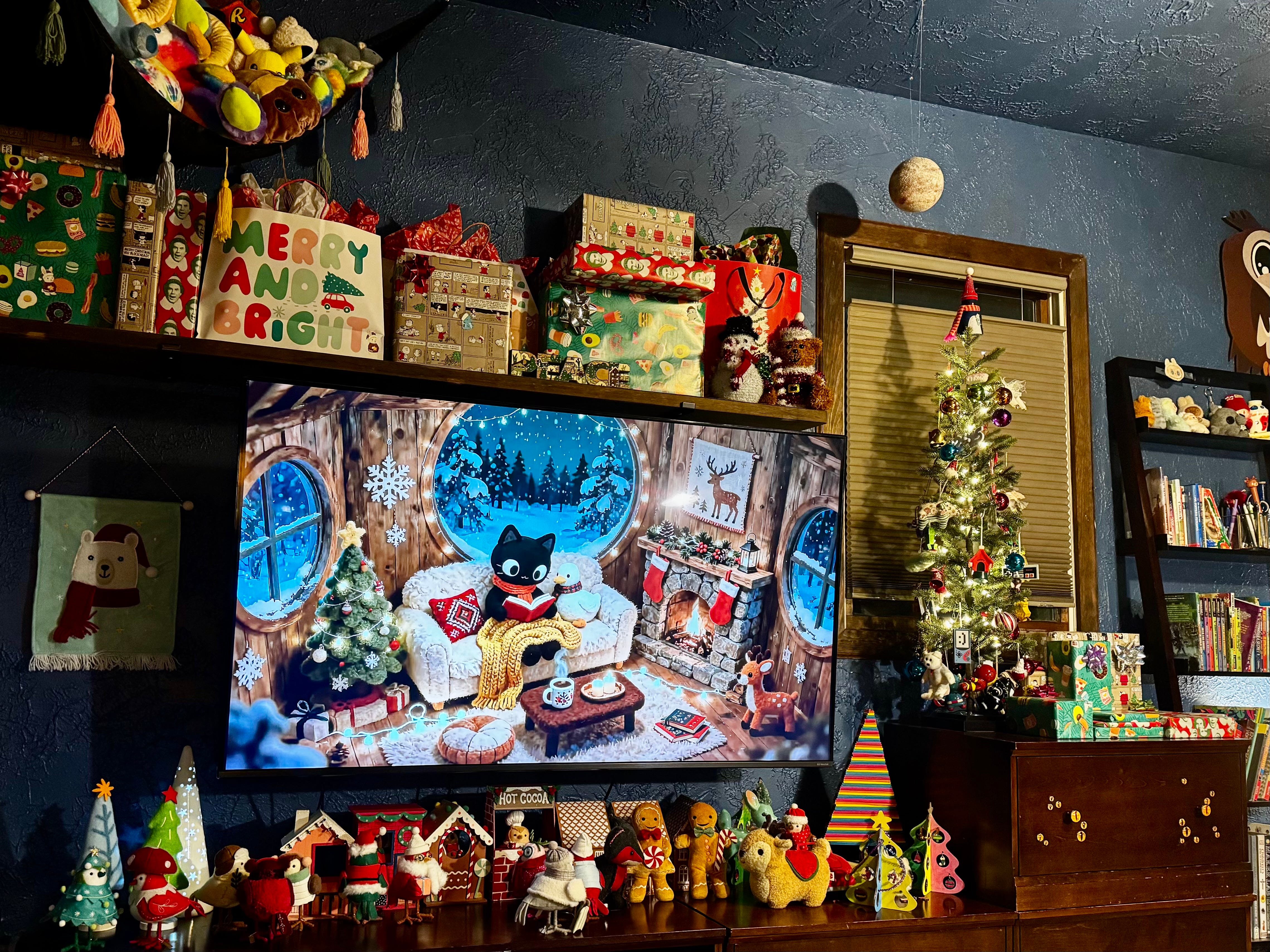
We wound up with a loose kawaii-fantasy theme that includes lots of elements they both enjoy—fairy lights, cute animals, sparkly ornaments, shelves full of collectibles. We painted one wall and the door pink, and left the rest of the room teal (for now).

Neither kid got their original vision. We all worked together to create something new that both of them like.
This process is slower and more annoying than just picking a side, telling the ‘easier’ kid to compromise and calling it a day—the adults have to commit to treating both kids’ ‘wants’ as legitimate instead of competing claims on our patience.
The good news is that the slow annoyingness has an actual purpose:
The kids are learning to communicate instead of just reacting. “I hate Disney stuff” is a lot easier to articulate than “I want the room to feel calm and a little serious, and all these Frozen stuffed animals make it feel chaotic to me.” Getting my kids to sit with a preference long enough to communicate what’s underneath it is a skill that will serve them far beyond their childhood bedroom.
They’re learning that conflict doesn’t have to end with winners and losers. “You get the wall, she gets the shelf, now everyone stop talking about it” teaches kids that compromise always means getting less of what you want. The kawaii-fantasy bedroom shows them that a good solution doesn’t need to be a smaller version of their original idea, it can be a third concept that neither kid would’ve thought up alone.
And they’re learning that their ideas can survive contact with other people. Flexibility isn’t the same thing as being a doormat. We can co-exist with others, respect their interests and ideas, and be true to ourselves.
My goal is a livable home, not absolute control.
When one of my kids was little, they wanted to keep everything—baby clothes they’d outgrown, the packaging toys came in, all of it. Every ripped scrap of sparkly tissue seemed to have a deep, mystical hold over this kid.

I wasn’t willing to live in a house overrun by literal garbage and things none of us could use, so ‘just roll with it’ was never on the table. I’d tell my kid they could keep anything—but they couldn’t keep everything (phrasing I’m pretty sure I got from Dana K. White, who I think is a fantastic resource for neurodivergent folks struggling with household maintenance).
We have a limited amount of physical space in our house, and that’s the boundary. It’s not even my boundary, really, it’s just me . . . recognizing the boundaries of reality, I guess? Once a container (a drawer, a closet, a room) is full, we have to declutter before anything new comes in. Until one of us figures out how to make a personal pocket dimension, space is finite.
The boundary is mine to hold because it’s my responsibility to fix things when a hallway becomes a fire hazard.
But decisions about how to operate within the boundary? Those are my child’s decisions. Unless there’s a safety concern (like wanting to keep something broken with a jagged edge), they choose what to keep. My kid is the one who has to live with their items, use them, wear them, and maintain their room day-to-day. Their responsibility, their call.
Respecting those decisions meant giving up hope of (what I considered) a ‘sensible’ outcome. My kid’s value judgments just weren’t going to match mine, full stop. The colorful packaging is more interesting than the toy? Fine, I guess. And I don’t get a vote on the $80 Mini Boden dress vs. the hand-me-down Children’s Place sweater, even if I really, really want one.
My child’s decisions aren’t mistakes for me to correct—they’re preferences I don’t have to share.
And don’t get me wrong, I often felt like tearing my hair out over my kid’s weird choices. I had to set firm boundaries for myself to help me focus on my actual goal: communal participation in keeping the house manageable and functional for the people who lived in it.
The goal isn’t to get my child’s preferences to conform to mine (cue deep breathing, repeat mantra as needed).
The distinction is subtle, but it’s everything in PDA. A rule about function (‘storage spaces need to work for everyone using them’) lands differently than a value judgment (‘you have to get rid of all that useless junk’). It’s not ‘I set the rules, kids get some input as a treat.’ It’s the same rule applied to both of us: anyone responsible for this domain gets agency over it, too.
I don’t declutter for my kids (even when I really want to).
I completely understand the temptation to wait until the kids visit Grandma, drag a black garbage bag into their rooms, and disappear one-third of their possessions. Decluttering together is a colossal pain in the ass and can involve an unreasonable amount of time spent listening to detailed stories about a plastic pony with no head.

I’m not saying this is the One Right Way™ to handle this. I’ve actually found that, for myself, having someone else come in and start the process without me reduces my overwhelm and anxiety and keeps me from spiraling into a self-defeating loop of doom:
‘This has to be done first, but THIS can’t be done until THAT other thing is done, so nothing can get done, and now I’m salty because no one will help me figure out how to solve a problem that I’ve made theoretically impossible.’
I’m fun to live with.
My long-term goal here is to support my kids in building household management skills that actually function for them. They aren’t going to figure out how to navigate demand avoidance, executive dysfunction, or decision fatigue if I’m always keeping them away from the friction because it’s easier for me to do it by myself.
A grumpy-face truth about parenting is that easier for me today, often just means a disaster for both of us in five-to-ten years.
I’m not issuing commands, I’m communicating my bandwidth.
A lot of PDA bloggers hate ‘if/then’ (or ‘first/then’), but I looooove it. ‘If/then’ is just facts, y’all. I’m sharing information about the limits of space, time, and my own capacity so my kids have real information to work with.
“If I can get the kitchen clean in time, then I’m happy to take you to the zoo.”
It’s not ‘clean the kitchen or no zoo.’ It’s honesty: I’m not comfortable going to the zoo knowing that I’ll be coming home to a pile of dishes and miscellaneous kitchen goop that I’ll still have to deal with. Cleaning the kitchen takes time, and if it takes all the time, I won’t have time to go to the zoo.
Maybe the kids help with the kitchen because they want to go to the zoo. Maybe they don’t, and we don’t go.
I think this is where a lot of ‘no demands, ever’ PDA advice runs aground in the real world. I’m not a limitless resource. Pretending that I am (smoothing over every uncomfortable reality, hiding my own needs, contorting myself into a pretzel to avoid sounding like I’m setting conditions or holding boundaries) isn’t accommodation. It’s dishonest, and frankly, I think it’s a fast-track to parents burning out or flying off the handle.
The rule cuts both ways, remember? They get agency over what they maintain, I get agency over what I maintain, including my own bandwidth. ‘If/then’ isn't me withholding a reward to compel labor we haven’t agreed upon; it's me being honest about my own limits.
If it’s worth doing, it’s worth doing half-assed.
I believe that KC Davis, author of How to Keep House While Drowning, popularized this quote, and I’ve tried to teach this philosophy to my kids. Putting your laundry away imperfectly is better than letting the cats sleep on it. Washing three of your dishes is better than seeing how long it takes for the congealed ooze to gain sentience. Doing anything is better than doing nothing.
Look, I strongly believe that no human being genuinely wants to live in a chaotic doom pile, so I try—and I really emphasize try here, because I’m human and sometimes the stray shoe is my last straw—to operate on a simple assumption: people want to be functional.
When I look at my kids’ rooms (or my own closet floor, if I’m honest) I get better results if I approach things from a place of curiosity: where is this system falling apart, and how can we hack it?
Is there an issue breaking down ‘clean your room’ into specific, actionable tasks?
Do we currently own more items than we can maintain in this space?
Are there friction points we can eliminate, like folding pajamas or underwear?
Do we need different storage solutions (like labels or clear bins) that help us remember where things go?
None of this is about creating a Pinterest-perfect home—Pinterest is all AI now anyway. It’s about creating systems that reliably work for the people who actually use them.
I personally find James Clear’s writing style kind of preachy, but I still think a lot of Atomic Habits is pure gold, like: you have to standardize a habit before you can optimize it.
A lot of well-meaning advice tends to start with the optimized vision, so you end up chasing something more complex than the habit underneath it will support, which is a great way to wind up crying in the corner at two in the morning (don’t ask me how I know this).
Doing things half-assed isn’t failure, it’s step one: get the laundry in the hamper, every time. Standardize first. Optimize later—or never, if that’s what it takes. An ugly system that sort-of works beats an elegant one that nobody ever uses.
I think about this a lot re: my kids, because the instinct (mine and theirs) is to aim for the finished, perfect version on day one. It’s very human to want to be great at something without working at it, right?
But skipping standardization tricks kids into thinking they’re falling short. When their messy, learning-to-standardize results don’t match the optimized fantasy, the gap between ‘who they are right now’ and ‘who they think they’re supposed to be’ gets filled in with a story about why.
And that story usually isn’t very forgiving: ‘I’m lazy,’ ‘I’m a failure,’ ‘something is broken in me.’
The sock drawer isn’t a moral test.
This system only works if labor earns agency regardless of how well it’s done. When we grade good-faith participation according to our own subjective standards, agency-for-labor becomes worth-for-performance.
This doesn’t mean that parents and caregivers can never have standards, but it’s worth examining what we’re really asking. “Did you do it in a way that works?” isn’t the same question as “Did you do it my way?”
If the standard we’re trying to enforce is really an aesthetic preference, that’s not a labor problem. ‘Washed’ dishes still covered in food obviously need to be addressed (Mice! Bugs! Gross!), but unfolded socks in the drawer still count as ‘socks put away.’ When we treat a difference in preference like a failure of character, kids hear 'fuck your ideas, any way other than my way is the wrong way.'
Shame is not a sustainable motivator. No one builds healthy life skills because someone shamed them into believing they were a lazy piece of garbage. And even if it did work, now you’ve internalized that you’re worthless trash, so you have a whole new problem—one that’s a lot fucking harder to solve than disorganization.

Mess is annoying, but it’s fixable. You can’t buy a clear bin to solve unstable self-worth built on ‘I only have value when I perform perfectly.’ And perfectionism can become a shield against the crushing pain of inadequacy: ‘If I can’t clean this room completely, perfectly, and sustain it forever, there’s no point in starting.’
When ‘I made a mess’ becomes ‘I am a mess,’ your worst fears about yourself become your identity. If we take moral judgment away, we give our kids (and ourselves) permission to be imperfect humans who learn by trial and error. We aren’t deep-cleaning to achieve perfection; we’re doing it so we can stumble back through our front door, exhausted, and feel relieved to be home.
There's a lot to appreciate here, but I mostly want to say that my (anxious, probably PDA) tween was reading over my shoulder and laughed, then said "'spiraling into a self-defeating loop of doom.' Wow, relatable."
Also love Atomic Habits! And also the expression ‘Perfection is the enemy of good enough’