

With Pathological Demand Avoidance, Make-Believe Can Be a Must
Fantasy and pretend play have always been my most effective PDA accommodations.

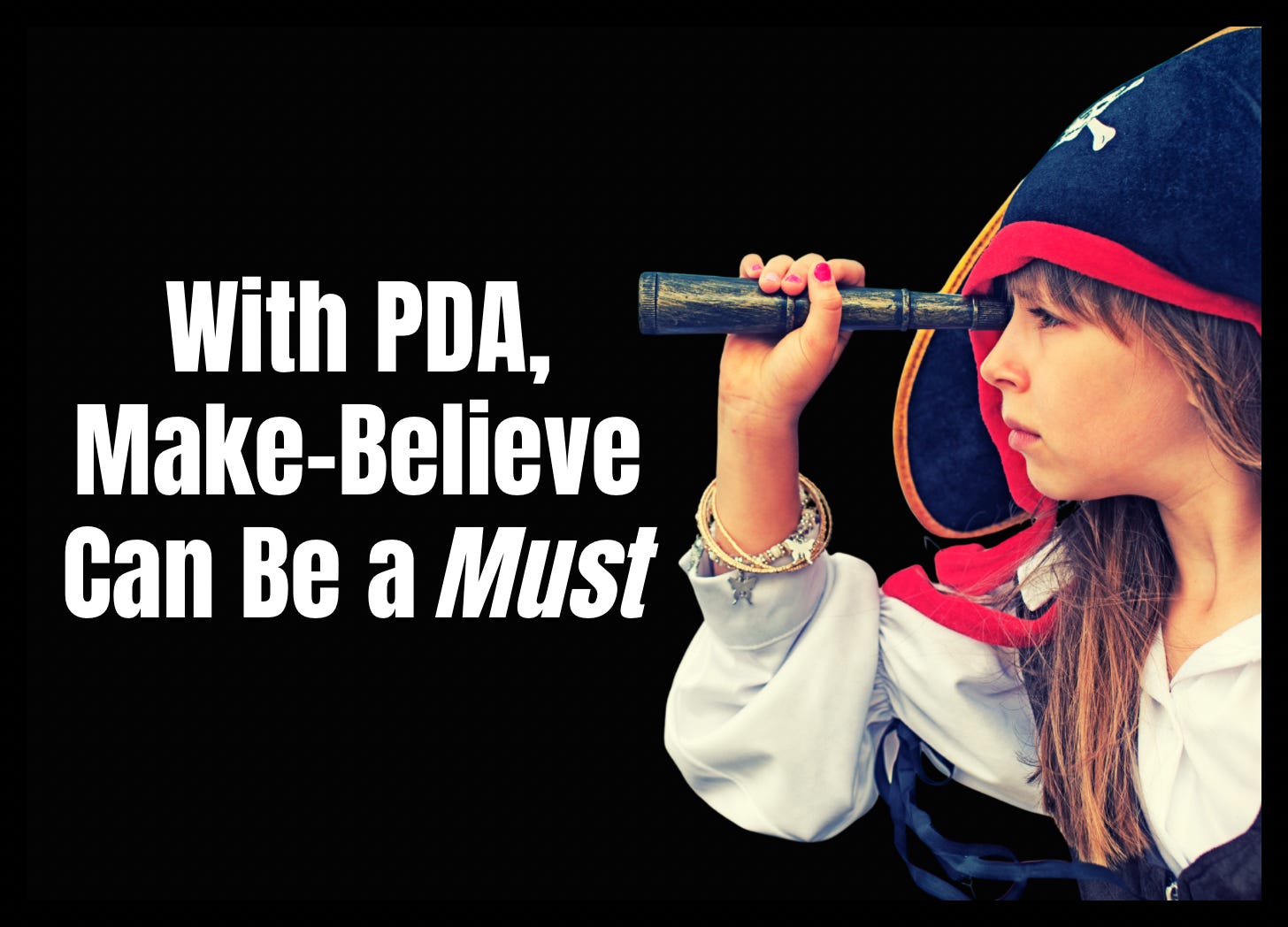
I always wanted to play make-believe as a kid. For months, I insisted I was Minnie Mouse and refused to answer to my own name! As an only child, my mom was my primary playmate, and I ran our games with a fierce, non-negotiable intensity. My favorite game structure was simple: “I’ll play the princess and the witch—you play everybody else.”
Adults saw it as a vivid imagination, but looking back, I think it was much more than that.
Finding Sanctuary in Pretend
As a child, I didn’t have the language to explain that living under modern social hierarchies left me feeling like a trapped animal ready to gnaw off its own leg. I couldn’t understand why seemingly minor demands, things that registered to other people as harmless or automatic, caused me agonizing internal friction.
It was a constant, exhausting cycle where my brain screamed DANGER at the ordinary mechanics of being alive. Activities of daily living, deadlines, social obligations, and even goals I set for myself could trigger a visceral panic response.
But in my fantasy worlds, the relentless expectations vanished. If a situation felt too threatening, I could rewrite the narrative on the spot. Inside a story, I could step away from the pressure of the real world and enter a space where choice, creativity, and agency were endless.
Playing pretend wasn’t a cute childhood phase. It was a survival mechanism.
Imaginative Reframing as an Accommodation
Make-believe is often seen as a developmental phase we’re supposed to outgrow—something children use for entertainment until they’re mature enough to meaningfully engage with reality. But as an AuDHD (Autism and ADHD) and PDA (Pathological Demand Avoidance) adult, I still rely on make-believe to navigate and understand the world.
Honestly, I’d go so far as to say that playing pretend is my most effective accommodation.
Executive dysfunction is a huge barrier in my daily life. The ADHD part of my brain struggles to generate enough dopamine to initiate tasks, while the PDA part interprets pressure to engage with those tasks as a threat. I can’t start the task, and the more I try to convince, trick, or bribe myself to just do it already, the more threatened I feel.
I’m stuck. The harder I try to push myself, the higher the barrier becomes, and it feels like I’ve lost without ever even starting.
Make-believe is like a psychological exoskeleton that allows me to expand what I’m capable of doing without completely draining my mental and emotional reserves. When I’m unable to move forward, I can attempt to step into a persona designed to handle that exact stressor: maybe I can’t do it, but my character can.
For example:
Imagine a simple winter morning.
I need to:
dress in layers of clothing (a multi-step sensory nightmare)
leave the house
walk through the ice and snow
get to the bus stop on time
Viewed through a real-world lens, this task often feels impossible. My brain immediately fixates on the cold, the discomfort, the time crunch, the ridiculous number of literal and metaphorical steps required, and the lack of meaningful choice. I don’t have the internal resources to complete this task, and I’m only trying to force myself to do this because I have to.
But what if I change the script?
Instead of walking to a bus stop, I’m crossing the frozen Arctic in a desperate race against time. I cast myself in a Balto-like scenario: I’m transporting life-saving medicine to an isolated village, and the fate of the entire community depends on me reaching my destination.
Externally, nothing has changed. The weather is still miserable. I’ll still miss the bus if I’m not there on time. But internally, I’m no longer a tired adult dragging myself toward an obligation. I’m a hero on a life-or-death mission.
When motivation emerges from a story I chose to engage with, my internal resistance gets quieter. I’m less likely to panic over expending my limited personal reserves because I’m borrowing from the resource pool of a fictional counterpart.
Adults who readily accept calendars, reminder apps, and standing desks need to understand that imaginative reframing is simply another accommodation. It lowers the executive dysfunction barrier and helps me access abilities that would otherwise remain locked away.
But the reality is that society rarely treats this tool with the same basic respect given to a planner or an app. We pull the plug on make-believe right when the pressures of growing up start to compound.
When the World Says You’re Too Old to Pretend
Adolescence is hard on almost everyone, but the difficulty level is brutal if you already struggle with meltdowns, emotional dysregulation, and executive dysfunction. My teenage years were some of the hardest of my life, and I frequently hear from caregivers of PDA tweens and teens that puberty has made their child’s distress seem completely unmanageable.
Personally, I don’t think hormonal changes are the whole story.
For me, a massive contributing factor was that adolescence is the exact point we’re considered “too old” to play pretend.
In middle school, I suddenly found myself in a social environment where make-believe was heavily stigmatized.
The pressure to stop pretending wasn’t always explicit. No one sat me down and banned me from using my imagination, but the social cost of using it became incredibly high. Kids who still immersed themselves in fantasy were dismissed as immature by adults and labeled as freaks by their peers.
I used pretend play to process confusing feelings, experiment with social boundaries, and reclaim a sense of agency in a world that’s not built for my neurotype. Suddenly, my primary method of emotional regulation felt like a shameful secret I needed to hide.
It’s totally unsurprising to me that my mental health and behavior deteriorated during my adolescent years. We often talk about the challenges of peer pressure and increasing academic demands, but we don’t talk about the intense stress that occurs when a neurodivergent kid loses access to the only tool that helped them navigate those challenges in the first place.
Stripping away fantasy didn’t make me grow up, it just left me utterly defenseless.
Fantasy as a Bridge to Reality
In high school, I remember attending a theatre workshop where an actor mentioned that he felt more like himself when he was playing a character than he ever did in real life.
It was a massive click moment. That’s it, I thought. That’s me.
As PDAers grow older, reliance on pretend play can evolve into a variety of creative interests. Many of us find ourselves drawn to fantasy-oriented hobbies like TTRPGs (Tabletop Role-Playing Games), story-driven video games, cosplay, immersive theater, LARP (Live Action Roleplay), or creative writing.
These spaces offer something that can be incredibly difficult to find in the real world: structured freedom.
As an adult, I gravitate toward roleplay-heavy Dungeons & Dragons games that focus on character immersion and storytelling, leaning closer to Nordic LARP traditions than tactical combat simulations. These fictional worlds are where I process a lot of my real-life experiences.
Processing the world through a character allows me to approach heavy, difficult experiences that would otherwise feel too threatening. I can experiment with risky decisions, explore interpersonal conflicts, and experience profound emotional catharsis without imploding my real life. In roleplay, the stakes are transformed: the emotions are real, but the danger is gone.
Many people assume roleplay is about escaping reality, but for me, it’s always been the bridge that allows me to participate in it. Playing a character gives me just enough distance from the expectations, anxieties, and social rules attached to being “myself” that I can finally access my genuine thoughts and emotions. Inside a story, I can see myself clearly.
An Underutilized Tool for PDA Kids
Despite how fulfilling and restorative fantasy can be, it’s one of the most misunderstood and underutilized tools for supporting PDA children.
We’re not inherently more difficult, stubborn, or oppositional than other people. We live in a permanent state of internal resource exhaustion while constantly being expected to try harder, do more, and smile while we do it.
We’re being asked to learn to swim while we’re drowning, and no one ever bothered to ask us if we wanted to go into the deep end of the water in the first place.
When the basic demands of regular life constantly outpace your internal resources, protecting those resources becomes a matter of survival. You quickly become hyper-attuned to power dynamics and hidden agendas.
If a caregiver for a PDA kid changes their wording but continues to operate from a control-based mindset, the child will sense a trap. The phrasing might sound gentle, but the underlying pressure to comply with demands that outpace the child’s personal reserves remains.
When adults genuinely enter a child’s imaginative world, the power dynamic changes. In the real world, the adult holds all the authority. In fantasy, the relationship shifts away from a vertical hierarchy built around power and compliance and towards a more egalitarian partnership—you’re two Jedi, a harpy and a sea-witch, or a ranger and his faithful pet wolf.
Inside a shared story, the rigid roles of “adult who commands” and “child who obeys” cease to exist. You are both standing on level ground, playing by the rules of a narrative you wrote together.
There Are No Magic Hacks
But here is the critical catch that trips up well-meaning caregivers: this can’t be used as a sophisticated tool of coercion.
You can’t say, “Space Ranger, we have sixty seconds to seal our environment suits before stepping into the alien atmosphere!” when what you really mean is, “Hurry up and get dressed for your appointment because we’re going to be late.”
Sorry, there’s no magic hack.
Real connection isn’t built on finding clever ways to trick the PDA child into obedience. It’s built on a foundation of radical equality, trust, and shared joy. You’re teaching them that fantasy is important and that this is a safe place where they can process their emotions, not that it’s only valid if it “works.”
When you step into a story with a PDA child, you have to leave your real-world agenda at the door, embrace play, and let the story go wherever they need it to go.
WTF PDA?! is written by a PDA/AuDHD adult, married to another PDA/AuDHD adult, raising three neurodivergent kids. This newsletter is the running commentary on how I keep us all alive and (mostly) sane. I’m not an expert. I’m just really, really experienced.
I loved this piece so much! Our PDA son loves role play, and I’ve honestly found that it’s easiest to get him to comply when I enter his imaginary world (or use a ln acceptable bribe). But it’s so helpful learning about it from someone who’s on the inside of the experience. Thank you, super insightful 🫶🏻✨
Omg, the whole section on theater and role-play!!! I've said since high school that acting for me was about navigating truth (after an acquaintance said that she'd be a terrible actor because she's a terrible liar, and I took it personally). *The emotions are real, but the circumstances are not, which gives you freedom.* I always felt like I was more myself when I was in character - more able to access myself freely, but I've never heard anyone else say that in 47 years! Annnd subscribe.