

Tuesday Isn't Real
Anticipation, transitions, and the hidden demands of travel with autism, ADHD, and PDA.

I always recommend that people travel with their children as often as possible, as early as possible if they hope to travel together as a family. My kids have been traveling since they were babies, and they’re generally the best travel companions any human could possibly ask for.
So who is that curled up in the corner on the dirty airport floor, sobbing over a delayed flight?
Oh, yeah, it’s me.

I love travel, but I’m the worst traveler in my family by far.
I’m not great at the whole process of ‘getting ready’ in general. For anything. I’ve improved (some) over the years, but I’ve missed many things that I invested money in and was genuinely excited to do.
Concert tickets for a musician I love when one of my top-3 artists was the opening act. I bought tickets months in advance and then just . . . didn’t go.
A weekend trip I was excited about until it was time to pack the car, when, suddenly, I wanted to crawl under the blankets and cry.
Other PDA (pathological demand avoidance) people usually recognize this pattern immediately: it’s not that I don’t want to do the thing. It’s that all the little demands leading up to the thing are so goddamn overwhelming.
I hate anticipation.
Some people love that feeling of looking forward to something, and I think those people are crazy. The more I anticipate something, the more wound-up I get. I’d rather not get a gift at all, EVER, than have to know about it and wait for it.
Anticipation isn’t really one feeling—it’s the result of your brain’s attempt to predict how you’ll feel about a future situation. Psychologists call this affective forecasting, and it turns out that humans are really bad at it.
Most of us overestimate how intensely we’ll feel things in the future. And me? I already have really intense emotions, so boy oh boy, do I ever miss the mark when trying to predict the intensity of my feelings!
This, historically, has two outcomes:
The self-fulfilling prophecy: I overestimate how bad something will feel and dread it to the point that I’m physically sick and/or too exhausted to enjoy it, making it bad—even if it wouldn’t have been bad if I had just been normal about it.
The anticlimax: I overestimate how good something will feel, and when it’s not an absolutely euphoric, transcendent experience that fundamentally changes who I am as a person, I’m wildly disappointed.
But wait!
These two states feed into each other, creating a self-perpetuating loop of pure neurosis:
I’m aware that I overestimate how good something will be. Nothing gets to just be nice. It has to be THE BEST THING THAT HAS EVER HAPPENED TO ANY HUMAN, EVER, or it doesn’t count. And because I’m aware of it, I start to worry about how disappointed I’ll feel if the event doesn’t live up to my expectations.
That worry, of course, leads to me overestimating my disappointment, imagining some kind of life-shattering devastation that I never recover from.
Basically, I start to panic over the possibility of setting myself up for an anticlimax and create a self-fulfilling prophecy.
The not-knowing is the problem here. There’s a concept called intolerance of uncertainty—basically a personality trait where ambiguity itself, not any specific outcome, is what triggers anxiety.
I’m pretty great in an actual crisis, and I have a reputation for making the ‘impossible’ possible, like finding ways to go on trips I can’t afford (cough).
But a week of uncertainty? I completely lose my mind.
A crisis is a single, specific demand that arises from my circumstances: do this, now.
An ‘impossible’ situation is a puzzle to solve.
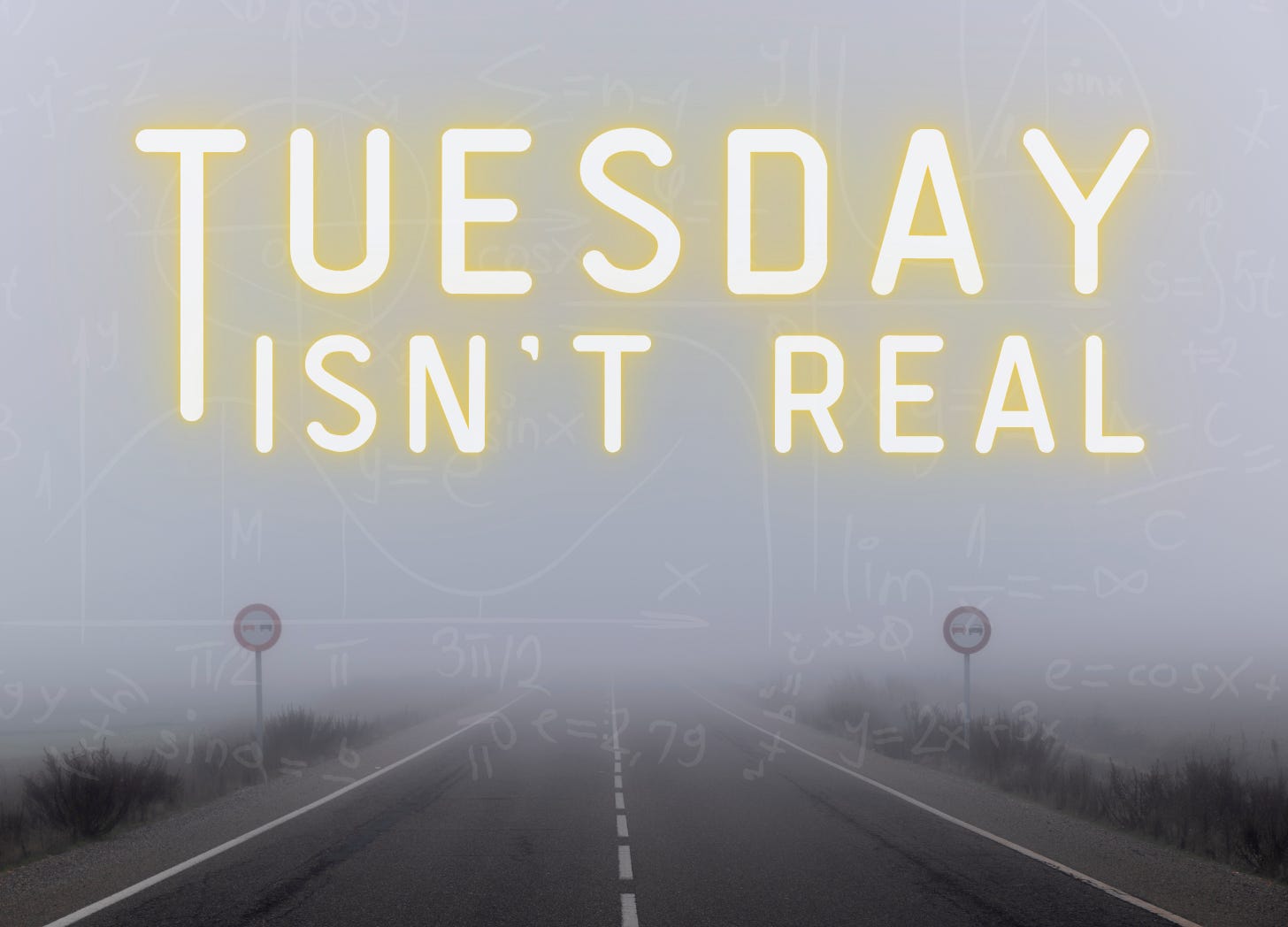
But prepare for Tuesday? That’s a fog of a hundred shapeless demands, just hanging in the air for weeks on end.

I don’t know when to start things???
I still, honest-to-god, don’t know how people pack in advance. I struggle to imagine things ahead of time. The picture of what any specific event looks like, and what I’ll need for it, doesn’t come into focus until I’m right on top of it.
And woe betide me if I need to order something.
This isn’t procrastination in the ‘I know what to do and I’m avoiding it’ sense. I can’t pack for Tuesday on Saturday, because Tuesday hasn’t rendered yet.
Tuesday is not real.
I know, abstractly, that Tuesday is coming. I can tell you facts about Tuesday: what the weather forecast looks like, where I’m driving, when I’m supposed to be physically getting in the car.
But knowing facts about a day and being able to conceptualize it as a reality are two completely different things, and only one of them tells you what the fuck you actually need to be doing.
Saturday-me can recite her itinerary, but she cannot tell you, with any confidence, what shoes Tuesday-me is wearing. Her factual knowledge can actually make this worse: what shoes do you need for a 40% chance of rain?!
And then Monday night arrives and suddenly Tuesday is extremely real and I’m standing in front of my closet at 11pm, hyperventilating.
You know how in suspenseful movies and TV shows, sometimes they’ll do a chapter card to establish the day of the week, and this menacing noise cues you in that you’re getting closer to The Bad Thing?
That’s how my brain processes time.

Every day is just a title card: WEDNESDAY. [ominous chord]. THURSDAY. [chord gets slightly louder].
There’s no gradual dawning of ‘oh, I should probably start thinking about this now.’ There’s the gray mist of ambiguous anxiety and mystery-demands, and then there’s the title card that says MONDAY in a font that implies violence.
Only then does my brain go, OH SHIT TUESDAY IS A REAL THING, TIME IS ACTUALLY MOVING FORWARD MAYBE?!
Oh yes, I’ve tried ‘just start earlier’ four billion times. It doesn’t work. The problem isn’t really about needing time—I have the time. I need like . . . a stable concept of reality.
For me, attempting to plan too far ahead just means more days of simmering in my own sense of foreboding.
And I really, really want to be the kind of person who meticulously plans ahead. I fantasize about it—color-coded spreadsheets, a packing list drafted a month out, everything laid out on the bed the night before like a magazine spread. But that fantasy is a trap.
The fantasy isn’t actually about logistics, it’s about identity. I don’t want a spreadsheet because it’s helpful for me—I know, from many years of experience, that it’s not helpful for me. I want a spreadsheet because it would mean I’m the kind of highly organized person that has spreadsheets, and I think that person is better than me.
Not just better at packing—somewhere in my head there's a version of me who has never once had to buy a phone charger at an airport kiosk for triple the price, and she is intrinsically better as a human being.
Why would anyone be good at preparing for a trip that, on some level, they feel like they’re not worthy of going on in the first place?
I’m terrible at transitions.
Things like moving from my house to the car, to the store, back to the car? Extremely stressful. I rarely get an entire errand list done, because I consistently underestimate how much time I need to transition between different places—not physically transition, but mentally arrive.
For me, there’s a significant gap between ‘I have left the house’ and ‘I am now capable of functioning as a person in this new location.’
There’s a concept called ‘task switching’ that basically describes the ability to move between different tasks without getting stuck, and I swear to the gods, I do not have whatever this is. I’ll pull into a parking lot and just sit there, engine idling, staring at a Target like it’s the gates to Mordor.
This is PDA math nobody warns you about: it’s not one demand, it’s one demand per transition.
House to car: one demand.
Car to store: a brand new demand.
My brain doesn’t carry momentum—I have to puzzle out how to navigate each handoff, one at a time, over and over, like I’m reassembling a map from tiny ripped-up fragments. But when it’s all taped back together it’s just one straight arrow and a note that says: go in the fucking store.
And a convention center—like the one I'll be walking into this week—is basically a transition generator: parking lot to entry line to show floor to a specific booth to a game table to another game table, over and over, all day, four days straight. CURRENTLY RECONSIDERING MY LIFE CHOICES.
What (sort-of) helps? Accepting it’s going to be fucked up.
Look y’all, I don’t even know. I’m 39, and I’m still really, really bad at all of this. I honestly think part of what helps is accepting that I’m bad at it and that it’s going to look like a mess and just doing it anyway because people who are a mess still deserve to live their lives.
Our family motto is actually ‘We do it anyway!’ which started as a joke based on my history of biting off more than I can chew—like enrolling in an advanced yoga workshop after four classes and nearly passing out in a room full of people who could casually fold themselves in half, backwards.
But that motto has served me pretty well over the years. It reduces the endless demands into something small and irreverent enough to slip past my own resistance.
Showing up late, underprepared, disheveled, and flustered is a different kind of failure than the concert tickets I paid for and never used. One is messy. The other is absent.
Somewhere along the line I learned that if I want to live my life, I’m going to have to consciously embrace disaster.
When basic tasks like showering and brushing your teeth seem overwhelming, it’s really hard to tell where the deep end actually begins. So I just have to jump in wherever I happen to be standing. I might be in over my head, but I’m in.
I had to take a deep breath when I got to the end. I feel challenged, really challenged! The "I'm in" statement triggers my avoidance big time! And I'm smiling quietly to myself now because I do that too, but gee, just the thinking about it is hard.
I'd get physically sick and miss out on things I'd looked forward to as a child. By the time I reached my teens I had taught myself to not get excited, not anticipate, in an effort to avoid the resultant migraine and vomiting.
We’ve been singing “I do it anyway” around the house lately. 😂 On travel though, we flew with my 4 and 2 year old to Indonesia once. They were undiagnosed, I was undiagnosed and it was pure hell. The 4-year-old screamed the last two flights and pretty much refused to switch time zones until the last day. That scarred me for life. With 5 neurodivergent kids, traveling is hellish, and we only do it if we absolutely have to or we love it (the beach once a year) and in driving distance of 2.5-3 hours. It’s just not worth it to us, but everyone is different.