

PDA Is a Nervous System Disability, According to Everyone but the Evidence
Coaches for pathological demand avoidance charge struggling families up to $5,000 a month for certainty that’s not backed by science.

Pathological Demand Avoidance (PDA) advocates and coaches often define PDA as an anxiety-driven nervous system disability, where real or perceived demands trigger the body’s stress response: fight, flight, freeze, or fawn.
But here’s the wild part: ‘experts’ talk about PDA like we've already figured out exactly what's going on in the brain. And we haven't. It's not even ambiguous—it’s not a “some studies say yes, some say no” situation. There's no neuroscientific evidence that PDA is a distinct nervous system disability. There's some preliminary work trying to characterize PDA traits, but nothing even close to establishing a mechanism.
And y’all, before anyone starts writing angry comments about PDA denialism, I have PDA. I think PDA is a useful term for describing real, similar lived experiences, but “this is something people struggle with and no one knows what’s causing it” and “this struggle is definitely caused by your autonomic nervous system malfunctioning” are two wildly different sentences.
My non-expert, lived-experience-flavored guess is that people who identify with the PDA label almost certainly don't all have the exact same issues, and that people who insist they have all the answers are selling you something.
Comparing Controversial Diagnoses: PDA and Fibromyalgia
Fibromyalgia is a diagnosis of exclusion, meaning that clinicians rule out everything they can prove, and then make an educated guess based on the patient’s symptoms. The leading theory for fibromyalgia is central sensitization, the idea that the central nervous system misfires and amplifies pain signals. It's a real theory that’s taken seriously, but it’s also unproven and contested.
And even the proponents of central sensitization don't agree on why it happens. The proposed factors include genetics, prior injuries, stress, personality traits, and trauma—a choose your own adventure of potential causes.
And the honest answer is that we don’t know what causes fibromyalgia. Even a supportive clinician is just making an educated guess and doing their best to make their patient feel better. This doesn’t mean that people with fibromyalgia aren’t genuinely suffering, it just means we don’t understand the source of their suffering yet.
Spoiler: It's Several Different Conditions in a Trench Coat
When a condition is defined by a checklist of symptoms instead of a known biological cause, that label commonly winds up describing several different distinct conditions that look similar.
This happens for multiple reasons:
Equifinality
Complex health conditions don’t usually have one single cause, so different starting points can lead to the same finish line.
Two people can both end up with severe depression for completely different reasons. One person’s depression might come from a genetic predisposition, while another’s comes from traumatic experiences with no genetic link at all.
The diagnosis is identical despite completely different causes.
This is why precision medicine tries to tailor treatment to the individual—knowing why someone got somewhere matters when you’re figuring out how to help them.
Variable Trajectories
Two people with the exact same diagnosis can have completely different experiences. One person responds quickly to a standard treatment and gets better, while another gets worse over time or cycles through sudden flare-ups. The actual path each person's illness takes is unique, and they may need totally different treatments to see any progress.
Overlapping Boundaries
Medical conditions are often grouped by their symptoms, but symptom groups rarely have clean, sharp edges—fatigue, chronic pain, and brain fog are symptoms of a ton of unrelated conditions. It can be incredibly difficult for doctors to tell where one diagnosis ends and another begins, which makes drawing a clear line between two distinct conditions with similar symptoms tricky.
The important point is that neither PDA nor fibromyalgia have a confirmed mechanism. Both are defined by their symptoms, which is the exact setup that tends to produce a single label accidentally used to describe multiple conditions. While fibromyalgia has actual neuro-imaging studies suggesting distinct subgroups, PDA just hasn’t been studied that rigorously.
Is it possible that PDA is a distinct nervous system disability? Sure. But ‘it might get proven someday’ is an argument for research funding, not support for an established fact.
Again, in both cases, many people are genuinely struggling. The argument isn't the distress isn't real, it's the mechanism behind why people are distressed hasn't been proven—a very different argument that keeps getting muddied by the former.
So Why Did ‘PDA is a Nervous System Disability’ Take Off Like a Rocket?
It makes money. Lots of money.
Summits. Podcasts with recurring guests, where coaches interview each other and cross-promote. It's a closed loop where the same names circulate across each other's platforms, amplifying one another's reach until the whole thing starts to look like consensus instead of what it actually is: an echo chamber.
The enthusiastic embrace of the "nervous system disability" framing isn't incidental—it's marketing.
When a parent or caregiver is dealing with a child in severe, daily distress, and traditional clinicians only offer compliance-based behaviorism or a blank stare, that parent is desperate. The system has entirely abandoned them.
Capitalism smells the desperation and circles like a vulture.
The strategy is simple: convince a struggling family they're dealing with a specific nervous system disability, brand yourself as an expert, frame the accommodations as incredibly specialized knowledge, and lock that knowledge behind a paywall.
Done? Congratulations! You just created a market to sell your framework.
But a framework that can't be checked against ordinary evidence isn't really functioning as a diagnosis anymore. Its real message to the parent or caregiver is trust the framework I'm selling you, not here's what's actually going on.
Here’s the thing: predatory marketing doesn’t require the underlying idea to be false.
I absolutely agree that behaviorism and compliance-based parenting practices suck. Not just for PDA kids—they just suck across the board. The problem isn’t that PDA coaches believe an unproven hypothesis, it’s that they present an unproven hypothesis as established scientific fact and use that false certainty to market their services to a desperate, vulnerable audience.
And PDA coaching programs are not cheap. Let’s examine one that I think is blatantly fucking predatory:
Case Study: At Peace Parents and Why I Think They Fucking Suck

Private coaching with Casey Ehrlich of At Peace Parents costs $5,000 a month and requires a 3-month minimum commitment.
Other coaches working for her cost between $575 and $1,750 a month.
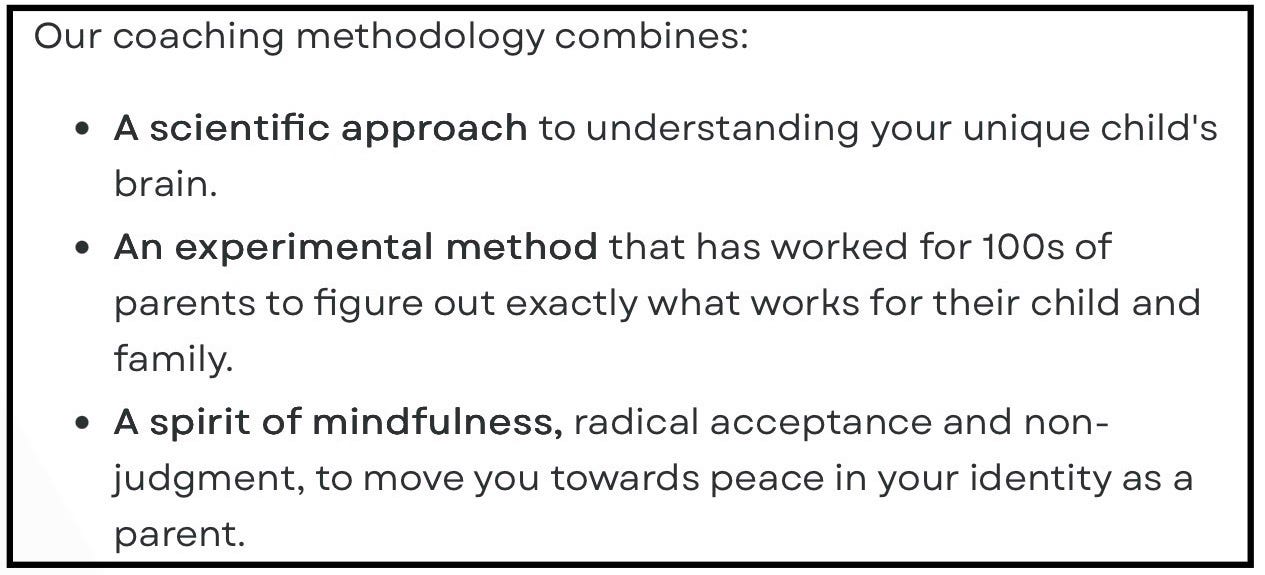
At Peace Parents explicitly promises coaching that uses a “scientific approach to understanding your unique child's brain” despite the fact that there are no biomarkers to diagnose PDA, no standardized diagnostic criteria, no validated diagnostic tests, and no consensus on evidence-based treatment.
But don’t worry, they’re using an “experimental method that has worked for 100s of parents.”
Worked . . . how?
Worked to reduce meltdowns? Worked to calm the parent? Worked to help the parent feel like someone finally believed them? All of those are real and potentially valuable things. None of them are the same as ‘this experimental method is effective.’ By definition, if a method is proven effective, it’s not experimental.
The Paradigm Shift Program
Can’t afford three months of coaching that costs as much as a year of licensed family therapy? Don’t worry, the Paradigm Shift Program ‘only’ costs $1,450, or $1,690 if you use a ten month payment plan—an implied APR around 34%, which seems a wee bit outrageous.
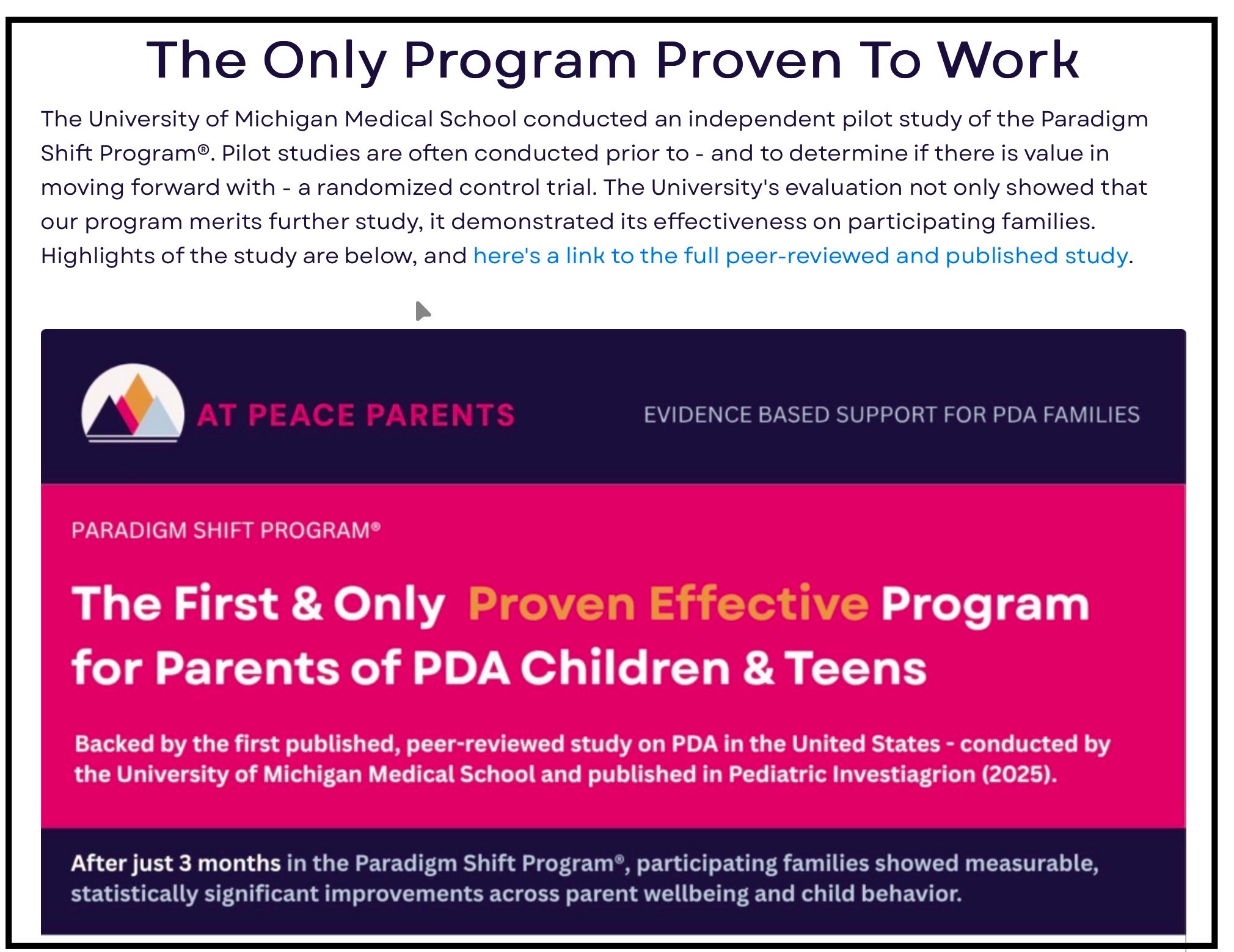
The Paradigm Shift Program is marketed as “the first and only proven effective program for parents of PDA children and teens,” referencing a pilot study conducted by The University of Michigan Medical School. The problem is that this study has a number of limitations, and absolutely does NOT prove that the Paradigm Shift Program is effective.
A pilot study isn't asking "does this actually work?" It's asking "can I even pull this off?" The Paradigm Shift Program Pilot Study only concludes that the program "was both feasible and acceptable."
In other words:
Can this program actually be run?
Will people stick with the program?
Do people find the program acceptable?
Questions about feasibility and acceptability have a much lower bar than questions about efficacy, and pilot studies are explicitly understood in research methodology as a precursor step used to justify running a real randomized controlled trial, not as a substitute for one.
The Paradigm Shift Program Pilot Study:
Is self-reported with no control group. Everyone who signed up for this study was using the Paradigm Shift Program, and their results are just their own before-and-after answers on a survey. There wasn’t a separate group of similar families who didn't take the program to compare against. That means any improvement observed could be explained by things having nothing to do with the program itself, like:
Regression toward the mean—people often enroll during a crisis, which naturally eases somewhat over time regardless of intervention.
Increased parental attention and effort from focusing on the problem.
Natural childhood development over time.
A placebo-like effect from finally getting the sense of ‘an expert with a plan is helping me.’
Featured 76 families who’d already paid to enroll in the January 2024 Paradigm Shift Program—which again, is at least $1,450. When people spend a lot of money on something, they tend to push down or ignore any doubts they have about it so they feel better about the value of their purchase.
Is 'statistically significant'—in the narrow technical sense that the changes reported probably weren't random noise. That's it. The study says nothing about why the changes happened, even though the marketing strongly implies otherwise.
Let’s Take a Deep Breath and Look at the Numbers . . .
In statistics, a probability value higher than 0.05 means the results could easily be due to random chance. This study establishes this right in the methods section: “P < 0.05 was considered statistically significant.”
If you look at the actual data table from the pilot study, you can see that the parents’ metrics showed statistically significant improvement, though there’s still absolutely no proof that the Paradigm Shift Program had anything to do with those improvements.
But what about the actual PDA children?
Not a single metric for child behavior cleared the study’s own bar for statistical significance.
Conduct problems? Failed (P=0.08).
Total behavioral difficulties? Failed (P=0.055).
Externalizing behavior? Failed (P=0.054).
The Paradigm Shift Program is marketed as showing “measurable, statistically significant improvements across . . . child behavior,” yet its own data shows zero statistically significant changes in child behavior.
And somehow the abstract calls this “a trend for significant improvement.” What?!
Even the researchers noticed some of their numbers don’t line up. When participants were asked directly whether their child’s behavior or their quality of life improved, most said ‘no.’
And here’s the kicker: buried in the discussion section, one paragraph before that closing summary, the same authors write, in their own words: “this study did not examine the effectiveness of the Paradigm Shift Program.”
The authors also call, explicitly, for a randomized controlled trial with an actual comparison group. That’s the researchers themselves telling you this study doesn’t answer the question the marketing claims it does.
And what really kills me about all of this is that Casey Ehrlich has a fucking PhD in Political Science. She knows what a pilot study is, she knows it’s not designed to prove effectiveness, but she uses it to disingenuously market her ridiculously expensive product as the “only proven effective program.”

In fact, she literally markets herself as “the leading researcher on PDA in the United States,” while doing some classic credential laundering. She just drops “PhD,” right next to "leading researcher on PDA," and lets your brain make the logical connections.
It’s not technically a lie, it's just designed to make you assume the credential and the claim are related. If the bio actually said "Casey Ehrlich, PhD in Political Science, is the leading researcher on PDA in the United States," that sentence would sound batshit insane.
So it just . . . doesn’t say it.
Sure, research methods generalize across fields, but familiarity with research methodology doesn't confer domain expertise in autism or PDA, and it especially doesn't make Ehrlich "the leading researcher" in a field she has no peer-reviewed publication record in outside her own company's pilot study that used her paying customers as the sole data source.
Then there's "using empirical evidence, cutting-edge science." WHAT EVIDENCE? WHAT CUTTING EDGE SCIENCE? The only research behind any of this is that one pilot study that concluded the program was "feasible and acceptable."
Remember, Ehrlich uses this kind of scientific language to justify a $15,000 minimum for private coaching. For 15k, you could hire a respite care worker for months so you’re not running on empty. You could soundproof a room in your house. Instead, this buys you three months of someone with a Political Science PhD telling you she has a scientific-but-experimental-but-also-proven-effective approach to your kid’s brain.
Look, I'm picking on At Peace Parents specifically because they're a huge name and a clear example, not because every PDA coach is running their exact playbook. But the structure—high-price paywalled 'expertise,’ selling certainty that doesn’t hold up to scientific scrutiny—shows up all over this space. There’s just a fucking chasm between the evidence that actually exists and the snake-oil salesmen confidently charging thousands of dollars for definitive answers that they just . . . made up.
Desperate families don't need proprietary frameworks based on hunches and locked behind a monthly mortgage payment. That’s not a paradigm shift. It's exploitation with a pretty landing page.
WTF PDA?! is written by a PDA/AuDHD adult, married to another PDA/AuDHD adult, raising three neurodivergent kids. This newsletter is the running commentary on how I keep us all alive and (mostly) sane. I’m not an expert. I’m just really, really experienced.
I absolutely love this. I couldn’t agree with you more. I am a person that offers PDA services to families and I am running myself into the ground financially to do so because I can’t BARE to charge these struggling (often single income) families in crisis more than the bare minimum, because that would be all that I could afford.
I come at this as a specialist through experience. I am a PDA adult. I have four children and two of them are PDA with opposing presentations. I have been teaching for 12 years in professional settings and the past three in a Home Education context for my PDA kids. I have some experience. But I make sure that people understand that I am in this bush fire WITH them. I read and translate research and studies for the purpose of making PDA accessible to families while defunking myths and trying to create a little clarity in a space which is quickly filling with salespeople.
It’s demoralising.
Anyway. The whole At Peace Parents rip off makes me want to go over there and give the woman a piece of my mind for taking advantage of people like this.
Phew. That’s off my chest. Thanks 🙏🏼
As a family psychologist who has treated highly demand avoidant kids for over 40 years, I am so grateful that you wrote this piece! I've been calling out these predatory influencers (and Casey Ehrlich in particular) for a while. Thinking I knew something about these kids and what works with them, I've joined several Facebook parent support groups for PDA (and one here on Reddit). Woof! That's been an experience to say the least. You're correct, these are echo chambers, and any voices that don't conform to the majority views (e.g., PDA is a nervous system disability, PDA kids can't change for the better, low demand parenting is the way to go, etc.) are loudly shouted down. I've been called every name in the book by both the influencers and the parents who gave them money. I try to politely give a science and clinically-based perspective, but I've been kicked out of these groups numerous times. Admins allow the bullying to occur, and it's clear that they suffer from the same biases and misinformation as the group members (and the same psychological incentives that prevent them from considering other perspectives. Thank you again for speaking out. I think we'll be reading more articles like this in the future, and I'm very much looking forward to that day.